My two children came into the world in pretty different ways: one dictated by ideals and the other by practicality. And while one of those births may look better from the outside, both of the experiences are precious to me, as are my two very different, very loved, children. And just like my kids teach me daily about being their mom, my births taught me about myself and how motherhood—sometimes imperceptibly, and sometimes all at once—changes everything.
For my first pregnancy, I knew that if my body and the medical profession would allow it, I’d have a homebirth. I read books on natural labor, like the classic Ina May’s Guide to Childbirth, and practiced nightly with a hypnobirthing CD. Homebirth felt like a means of proving my fortitude, a perfect complement to the all-natural, yoga-teaching street cred I had worked hard to cultivate. It felt important to set the tone for the kind of ideals-driven parenting I would soon rock; I was more determined than afraid.
On a cold midwinter’s night, regular contractions began. All through that night I was wakeful but calm—sitting, standing, pacing, breathing, staying present with the pain. By morning, my midwife had arrived, and the contractions were growing more intense. Sometimes I would get down on all fours and pant as if it were a blazing hot summer day instead of January in D.C. The female animal part of me was taking over, and that part didn’t give a damn about appearances.
As labor dragged on another day and night, I felt in each moment like I’d reached the limit of my capacity to do what I was doing. But the next moment I had to—and did—continue. My mother, anguished at my pain, begged me to go to the hospital. But barring an emergency, I didn’t even consider it.
After hours of pushing, my son was on the threshold, but stuck. Despite every effort to move him one excruciating centimeter at a time, he would fold back into me again and again. “I don’t usually do this,” said my midwife softly, “but I could cut an episiotomy.”
Knowing the answer in all of my tissues, macerated with pain and effort, I uttered just two words: “Do it.”
She took a scalpel to my most tender parts. The cut hurt—but not nearly as much as the seismic pulses my womb had endured— and with relief and a rush of blood, my healthy son was born.
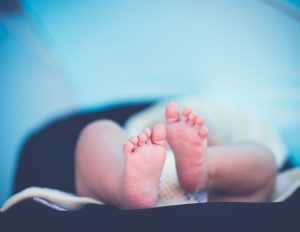
Moments later, I held his slippery body in my arms and knew that though the pain was real, it was in service to this life. I would now do anything to shepherd and nurture him.
My husband stood next to the bed with his hands on our son’s small back, tears in his eyes. At that moment my mother rushed in and snapped a picture of us looking wrung out yet substantial. The pain and my determination to get through the birth, followed by the dawning realization that, ready or not, we were parents had brought us wholly into the moment where nothing else mattered.
*
Though it took two months to recover from the tearing and episiotomy, I was proud of my homebirth. It felt like a badge of honor, like something I had to do.
Not so the second time.
Life circumstances had changed by the day, three years later, I faced giving birth to my daughter. My family had recently relocated to California, where I felt disoriented and isolated. Immersed in the beautiful mayhem of meeting a toddler’s constant needs, labor was something I began to see as important—not as an end in itself—but as a gateway. Perhaps, I remember musing in a haze of sleep deprivation and exhaustion, labor wasn’t the biggest decision of all; perhaps I could reserve my grit for the after-part, the mothering of two children that would follow.
My new midwife—cheery and efficient—also advocated homebirth, but I wasn’t convinced this time. As a mother who’d been in the trenches for a couple of years now, I had slowly, almost imperceptibly, migrated from the aspirational side of the birthing question to the practical one. But I neglected to tell my midwife how I felt, worried about what she and others might think.
With my second pregnancy, labor wouldn’t progress even after my water had broken. My midwife seemed dismayed that we would now have to go to the hospital, but in truth I wasn’t. I knew what awaited me afterwards: sleepless newborn nights, days with a needy toddler, the mothering of two. Labor, this time, was just something to get through.
At the hospital, Pitocin to start contractions led to more Pitocin to intensify them. When I asked for an epidural, my midwife’s face fell. “But you’ve done this before,” she said with the hint of a plea in her voice. “We know you can have a natural birth.” But it wasn’t that I couldn’t endure a second natural birth—just that I didn’t want to.
After a night’s labor on the epidural, my daughter was born into a clear California morning. And this birth, too—even with all the interventions and pain meds I once thought I would never accept—yielded exactly what it was supposed to: a healthy baby and mother. When my daughter, a tiny, perfect package of swaddle and powerful lungs, was handed to me, I felt just as swept into the gravity of that moment as I had with my first.
Giving birth, at its core and essence, is this: welcoming a child with open arms. Vowing to protect, nurture, and love the child from that moment on. I don’t need any particular kind of birth for that to be true.
My newborn daughter writhed and screamed, as she was meant to do. I put her to my breast, and though I was still numbed from the waist down, colostrum flowed. The birth was done, nothing left to prove.
Like this piece? Subscribe to our monthly newsletter for real stories about women on their journey to motherhood